Exam context
Ten minutes, one unfamiliar proof.
There are a few moments in school when a difficult subject stops feeling like a wall and starts feeling like a language you can speak. One of mine came during the final exam for EE 699: Digital Signal Processing, taught by Dr. Michael Johnson.
I was a Ph.D. student then. After finishing the previous six questions, I had about ten minutes left for the graduate-only question. I had never seen one like it, and my first reaction was that it might be beyond me. Instead of leaving the exam hall early, I decided to use the time for an honest try: go back to what you know and connect the dots.
I had always felt comfortable with mathematics, but I had not done this kind of proof in signal processing before—at least not since proof-based mathematics classes during my undergraduate degree. So I started with the definitions from class, followed the symmetry, and gave the problem an honest try.
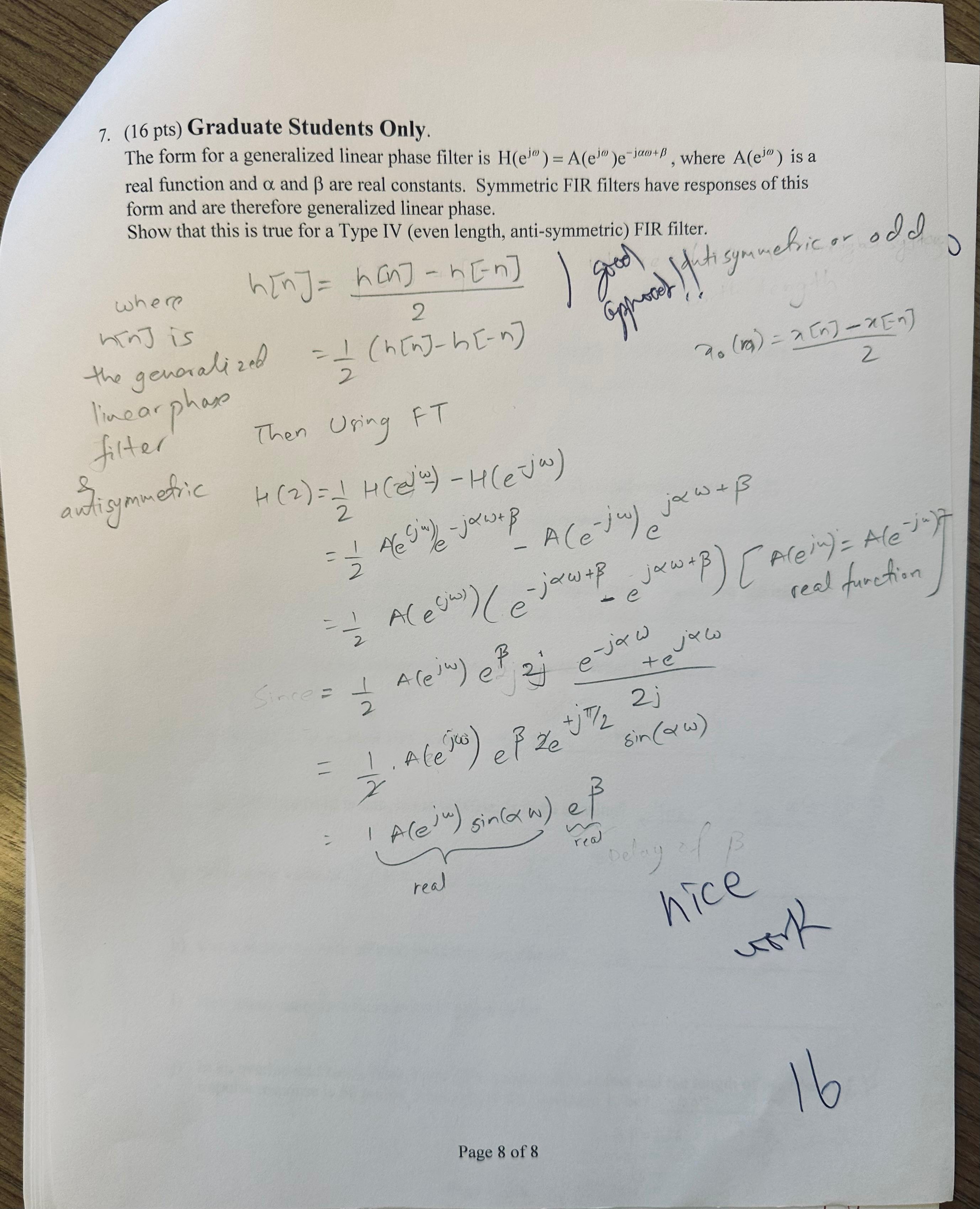
The question asked us to show that a Type IV FIR filter—an even-length, anti-symmetric filter—has generalized linear phase. It was not a trick question, but it asked for more than recalling a definition. It asked for the structure hidden inside the Fourier transform.
Why I remember it
Getting full credit felt good, of course. More than that, it was evidence that the ideas had started to connect: time-domain symmetry, frequency-domain phase, and the practical behavior of FIR filters were no longer separate facts to memorize.
It is a small academic memory, but it is one I keep. Signal processing has a way of rewarding patience: stay with the algebra long enough, and the pattern usually introduces itself.
The idea behind the proof
For a Type IV FIR filter, is even and the impulse response is anti-symmetric:
Start with the FIR transfer function, exactly as I did in the solution. The frequency response is obtained by evaluating it on the unit circle, . Then pair each sample with its reflected partner; anti-symmetry turns the second term into a subtraction:
The final line is the key insight: the paired exponentials become a sine term, while the remaining exponential is the delay about the filter midpoint. Define the real-valued amplitude term
Because the filter coefficients and sine terms are real, is real. Since , the response becomes
This is the generalized linear-phase form , with and . The delay is linear in frequency, and the anti-symmetry contributes a fixed 90° phase offset.
Put another way, the answer was not buried in a long calculation. Once the impulse response is grouped around its midpoint, its anti-symmetry forces the transform into the right shape.